Biography
Hayao Miyazaki was born on January 5, 1941, in Tokyo, Japan. Growing up during the aftermath of World War II, he was exposed early to the beauty of nature and the hardships brought by conflict. His fascination with art and storytelling was evident from a young age, and these experiences later shaped the fantastical and emotionally resonant worlds he created. Miyazaki’s early life was marked by a blend of traditional Japanese influences and Western animation, fueling his ambition to pursue a career in the arts.
In his teenage years, Miyazaki’s interest in animation took root. He found inspiration in the works of pioneering filmmakers and animators, and he began his formal career in the animation industry in 1963 with Toei Animation. Working as an in-between artist, he honed his craft and absorbed lessons from the rich legacy of Japanese storytelling and early anime. This formative period was crucial, as it laid the groundwork for the innovative techniques and deeply thematic content that would later characterize his films.
Miyazaki’s rise to international fame began in earnest with his directorial debut in 1979 with The Castle of Cagliostro. The success of this film, along with his subsequent work on Nausicaä of the Valley of the Wind in 1984, established him as a visionary storyteller capable of merging fantastical narratives with profound human concerns. His decision to co-found Studio Ghibli marked a turning point not only in his career but also in the realm of animated cinema, setting new standards for creative storytelling and technical brilliance in animation.
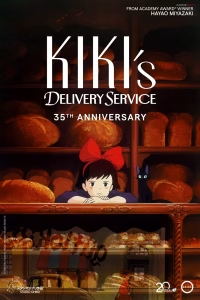
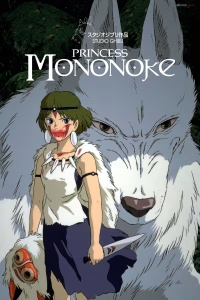
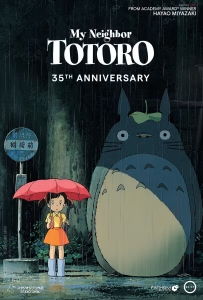
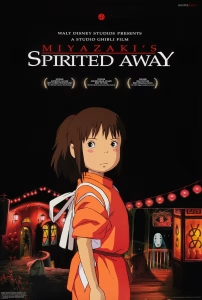
During the peak of his career, Miyazaki produced a string of critically acclaimed films including My Neighbor Totoro, Kiki’s Delivery Service, Princess Mononoke, and Spirited Away—the latter of which won the Academy Award for Best Animated Feature. His films are celebrated for their intricate narratives, strong environmental and pacifist themes, and memorable characters, reflecting a deep reverence for nature and the complexities of human emotion. At Studio Ghibli, Miyazaki’s commitment to hand-drawn animation and traditional storytelling methods stood in stark contrast to emerging digital trends, reinforcing his status as a guardian of a classic cinematic art form.
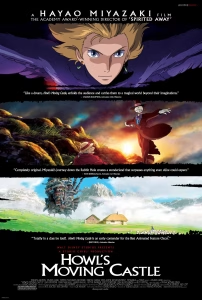
In his later years, Miyazaki continued to evolve as an artist, often oscillating between retirement announcements and triumphant returns to filmmaking. His later works, such as Howl’s Moving Castle, Ponyo, and The Wind Rises, further cemented his legacy as a master storyteller whose works transcend age and cultural boundaries. Beyond his cinematic achievements, Miyazaki’s personal life reflects a deep-seated philosophy of respect for nature, human resilience, and the enduring power of imagination. His films continue to inspire generations of artists and audiences around the world, ensuring that his legacy remains a benchmark in the fields of animation and film.
Art / Writing Style
Miyazaki’s art style is characterized by richly detailed hand-drawn animation, a blend of realistic and fantastical elements, and a deep sensitivity to nature and the environment. His work frequently emphasizes fluid motion, whimsical design, and imaginative landscapes that evoke both wonder and introspection.
Filmography
- Lupin III: The Castle of Cagliostro (1979)
- Nausicaä of the Valley of the Wind (1984)
- Castle in the Sky (1986)
- My Neighbor Totoro (1988)
- Kiki's Delivery Service (1989)
- Porco Rosso (1992)
- Princess Mononoke (1997)
- Spirited Away (2001)
- Howl's Moving Castle (2004)
- Ponyo (2008)
- The Wind Rises (2013)
- The Boy and the Heron (2023)
- The Castle of Cagliostro (1979)
- Nausicaä of the Valley of the Wind (1984)
- Laputa: Castle in the Sky (1986)
- My Neighbor Totoro (1988)
- Kiki's Delivery Service (1989)
- Porco Rosso (1992)
- Princess Mononoke (1997)
- Spirited Away (2001)
- Howl's Moving Castle (2004)
- Ponyo (2008)
- The Wind Rises (2013)
- Boro the Caterpillar (2018)
Notable Works
Bibliography (All Written Works)
Writing / Series Composition Credits
- The Castle of Cagliostro (1979)
- Nausicaä of the Valley of the Wind (1984)
- Laputa: Castle in the Sky (1986)
- My Neighbor Totoro (1988)
- Kiki's Delivery Service (1989)
- Porco Rosso (1992)
- Princess Mononoke (1997)
- Spirited Away (2001)
- Howl's Moving Castle (2004)
- Ponyo (2008)
- The Wind Rises (2013)
- Boro the Caterpillar (2018)
Production Credits
Notable Characters Created
- Totoro
- Kiki
- San
- Howl
- Nausicaä
- Chihiro Ogino
- San (Princess Mononoke)
Influences
- Akira Kurosawa
- Osamu Tezuka
- Disney
- J.R.R. Tolkien
- Hans Christian Andersen
Frequent Collaborators
- Joe Hisaishi
- Isao Takahata
- Toshio Suzuki
- Kazuo Oga
Known For
Awards & Recognition
- 01 Academy Award for Best Animated Feature (Spirited Away)
- 02 Academy Honorary Award
- 03 Order of the Rising Sun
- 04 Golden Lion for Lifetime Achievement
- 05 Venice Film Festival Golden Lion for Lifetime Achievement
Works (12)