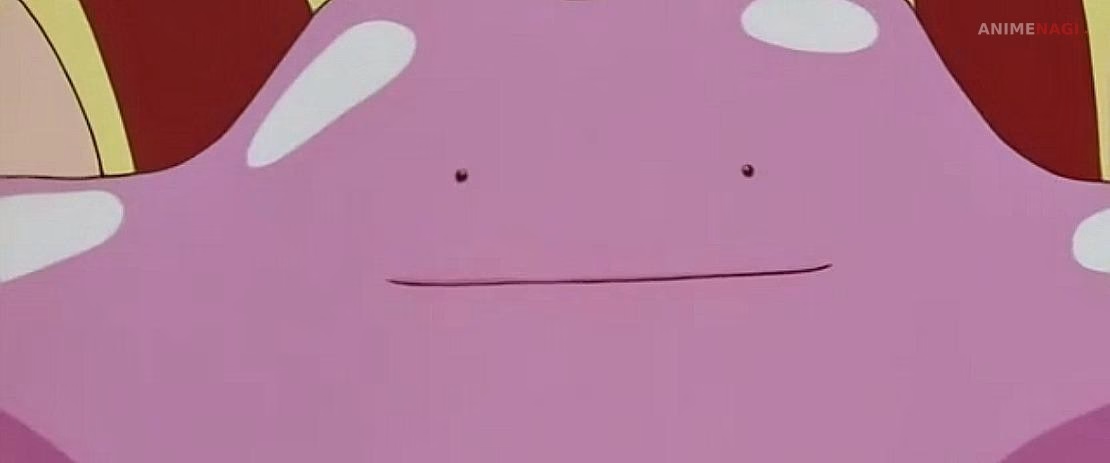
Few Pokémon are as deceptively simple yet endlessly fascinating as Ditto. At first glance, Ditto looks like one of the most basic creatures in the franchise, with its small pink blob-like form and minimal features. However, beneath that simple design lies one of the most unique and powerful abilities in the entire Pokémon universe. Unlike most Pokémon, which rely on fixed movesets and evolutionary paths, Ditto’s defining power allows it to completely transform into other Pokémon, copying not just their appearance but also their abilities and moves.
This single ability makes Ditto one of the most versatile and unpredictable Pokémon ever created. It can become almost anything it sees, turning battles, breeding mechanics, and even storytelling moments into something far more dynamic. At the same time, Ditto’s powers come with limitations and mysteries that have kept fans curious for decades.
Let’s break down how Ditto’s transformation works, why it’s so powerful, and what makes it one of the most unique creatures in Pokémon.
What Makes Ditto So Unique?
Ditto stands out because it breaks almost every traditional rule of Pokémon design. Most Pokémon are defined by their species traits, elemental typing, and evolution lines. Ditto, on the other hand, exists almost entirely outside those conventions. It does not evolve, has a very limited natural moveset, and relies almost entirely on its transformation ability to function in battle.
According to official Pokédex entries and summaries from Pokémon Red and Blue and later games, Ditto can restructure its cellular composition to mimic any object or living being it sees. This biological explanation gives its power a pseudo-scientific foundation within the Pokémon world.
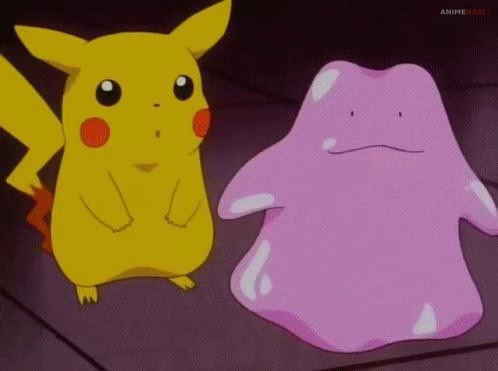
What truly makes Ditto unique is how complete its transformations can be. When it copies another Pokémon, it gains access to that Pokémon’s moves, stats, and even abilities in many battle scenarios. This effectively allows Ditto to adapt to almost any opponent.
However, Ditto’s simplicity is also intentional from a design perspective. Game Freak created Ditto as a flexible utility Pokémon, especially for breeding mechanics and strategic play. Over time, its role expanded beyond gameplay into anime storytelling and fan theories, making it one of the franchise’s most recognizable creatures despite its minimalistic design.
Ditto’s signature move, Transform, is the core of its entire identity. In both the games and the anime, this ability allows Ditto to copy its opponent almost instantly at the start of a battle.
From a gameplay perspective, Transform replaces Ditto’s stats and moveset with those of the target Pokémon, although certain limitations still apply. For example, Ditto typically copies the opponent’s moves but with reduced PP, which prevents it from becoming completely overpowered. Competitive players often use Ditto strategically to counter strong opponents by turning their own power against them.
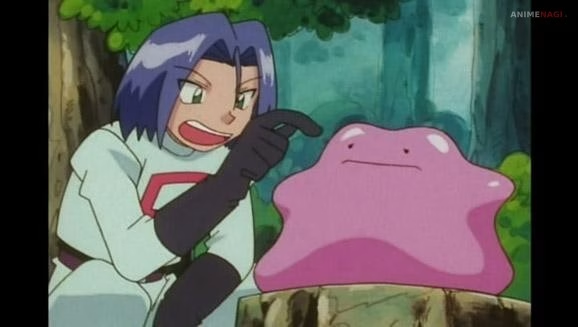
In the anime, the transformation ability is portrayed more flexibly. Ditto can copy not only Pokémon but also humans and objects in some cases. One of the most memorable examples comes from the Pokémon episode featuring a Ditto that struggles to replicate faces accurately, resulting in comedic yet revealing moments about how its ability works.
According to Pokédex descriptions referenced across multiple generations, Ditto’s transformation depends heavily on its memory. If it tries to transform based on memory rather than direct observation, it may produce imperfect results. This limitation adds an interesting layer to its otherwise overwhelming adaptability.
The ability also raises fascinating biological implications within the Pokémon world. Ditto essentially functions as a living template that can reconfigure itself at will, making it one of the most flexible life forms in the franchise.
Why Ditto Is So Powerful in Battles
Despite its simple appearance, Ditto can be incredibly powerful in the right situations. Its strength lies not in raw stats but in adaptability. By copying an opponent, Ditto effectively neutralizes stat differences and creates a mirror match.
In competitive Pokémon battles, Ditto is often used as a counter to high-stat sweepers. If an opponent sets up powerful boosts, Ditto can transform and immediately gain the same advantages. This makes it especially valuable in high-level play, where predicting and countering strategies is essential.
Another key advantage is unpredictability. Because Ditto can become any opposing Pokémon, it forces opponents to think carefully about their moves. This psychological pressure adds a strategic layer to battles that few other Pokémon can replicate.
However, Ditto’s power is highly situational. It relies entirely on the opponent’s strength, meaning it struggles against weaker targets or unconventional strategies. This balance ensures that Ditto remains useful without becoming overpowered.
The introduction of items like the Choice Scarf further enhanced Ditto’s competitive viability. By increasing its speed after transformation, Ditto can often act before the opponent, turning the tide of battle instantly.
The Hidden Limitations of Ditto’s Powers
While Ditto’s abilities are impressive, they are far from perfect. One of its biggest limitations is its dependence on a target. Without something to copy, Ditto is extremely weak and lacks offensive options.
In the anime, Ditto’s limitations are often used for storytelling and humor. The famous “Ditto face problem” episode shows a Ditto that can transform into other Pokémon but cannot replicate their facial features correctly. This highlights how precise and complex its ability actually is.
Another limitation is memory-based transformation. As noted in multiple Pokédex entries, Ditto may fail to perfectly copy something if it is not directly observing it. This suggests that its transformation process requires real-time visual data rather than stored information.
In battles, Ditto also struggles with durability. Even after transforming, it retains certain underlying weaknesses, making it vulnerable to strong attacks. Additionally, its reliance on the Transform move means it cannot adapt mid-battle without resetting its form.
These limitations are important because they prevent Ditto from overshadowing other Pokémon. Instead, they reinforce its role as a specialist rather than an all-purpose powerhouse.
Theories About Ditto’s Origins in Pokémon Lore
One of the most popular fan theories about Ditto is its possible connection to Mew. The theory suggests that Ditto may be a failed clone of Mew, created during early genetic experiments.
This idea comes from several similarities between the two Pokémon. Both share similar color palettes, body shapes, and the ability to use Transform. Additionally, both are linked to locations associated with genetic research, such as Cinnabar Island in the original games.
While this theory has never been officially confirmed by Game Freak or The Pokémon Company, it remains one of the most widely discussed topics in the Pokémon community.
Regardless of its origin, Ditto’s existence adds an element of mystery to the Pokémon world. It challenges the idea that all Pokémon follow clear evolutionary or biological rules, suggesting that there may be more experimental or unknown forces at play.