The ending of Takopi’s Original Sin delivers one of the most emotionally complex conclusions in recent anime. What begins as a seemingly simple story about an alien trying to spread happiness quickly spirals into a deeply unsettling exploration of trauma, loneliness, and unintended consequences. Across its short runtime, the series repeatedly shows how Takopi’s well-meaning interventions only worsen the lives of Shizuka and Marina.
By Episode 6, the narrative reaches a turning point where all timelines, mistakes, and emotional realizations collide. The finale does not offer a traditional happy ending, nor does it leave viewers in complete despair. Instead, it strikes a delicate balance between hope and loss. Takopi’s final decision reshapes reality itself, but at a heavy cost.
Let’s break down what really happens in the ending, how the new timeline works, and why the conclusion feels both uplifting and devastating.
Takopi’s Realization: Understanding Both Sides of Pain
One of the most important turning points in the finale is Takopi regaining his memories. It is revealed that he had originally arrived in a later timeline and tried to help Marina instead of Shizuka. When that failed, he attempted to manipulate time again, ultimately losing his memories and starting over.
This revelation changes everything. Takopi finally understands that both Shizuka and Marina are not simply the victim and the villain. Instead, they are both children shaped by pain, neglect, and toxic environments. Marina’s cruelty stems from her own suffering, just as Shizuka’s despair comes from isolation and abuse.
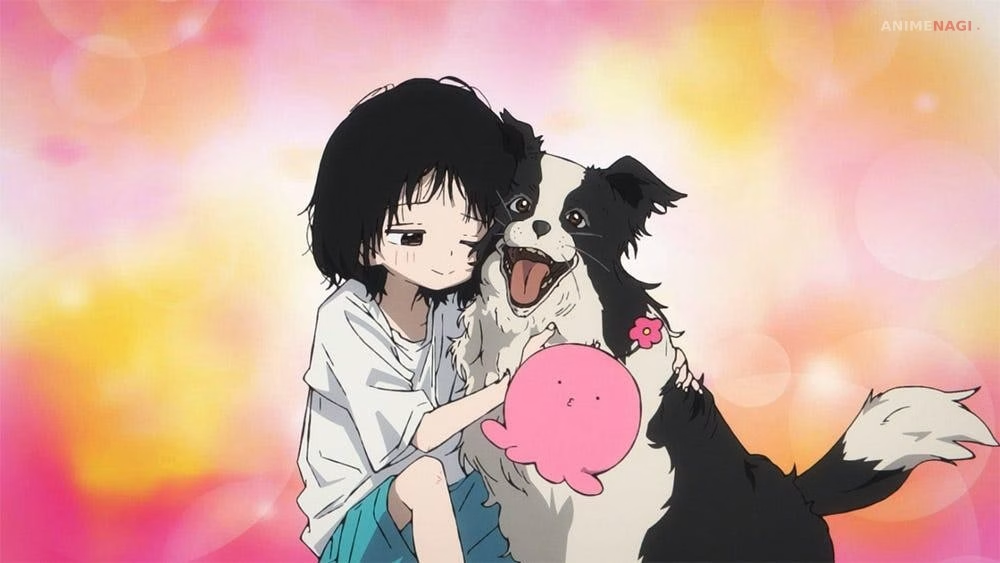
This realization is crucial because it dismantles Takopi’s earlier black-and-white thinking. Happiness cannot be forced by eliminating one person’s suffering at the expense of another. The story emphasizes that human emotions are complex, and there are no easy solutions.
After understanding the consequences of his actions, Takopi makes a final, irreversible decision. He sacrifices his entire existence to create a new timeline where both Shizuka and Marina can live without the catastrophic events he helped trigger.
This act is not just about fixing the past. It is about accepting responsibility. Takopi realizes that his presence, despite his intentions, has caused more harm than good. By removing himself entirely, he gives the two girls a chance at a more stable life.
The sacrifice is deeply emotional because Takopi’s only goal was to make others happy. In the end, he achieves that goal not through gadgets or time travel, but through selflessness. However, the cost is absolute. In the new timeline, no one remembers him.
The New Timeline: A Subtle but Meaningful Change
The world that emerges after Takopi’s sacrifice is not perfect, but it is significantly better. Shizuka and Marina still begin as children who dislike each other, and their circumstances at home remain difficult. However, a crucial moment changes everything.
Instead of escalating into violence, Marina notices a doodle of Takopi. This small, almost insignificant detail triggers an emotional response in both girls. Even though they do not remember Takopi, they feel a strange sense of loss and connection.
This moment prevents the chain of events that originally led to tragedy. Chappy is not taken away, Shizuka does not spiral into despair, and Marina’s hostility begins to soften. The timeline shifts not because their lives become perfect, but because a moment of empathy interrupts the cycle of harm.
The final scenes show Shizuka and Marina as high school students in 2022. They are not living ideal lives. Their family problems still exist, and the emotional scars have not completely disappeared. However, they are no longer alone.
Their relationship has evolved into a fragile but genuine friendship. They joke, argue, and support each other in small ways. This change may seem minor, but within the context of the story, it is monumental.
The ending avoids a typical “happily ever after” resolution. Instead, it presents a more realistic outcome. Pain does not vanish, but it becomes easier to bear when shared. This grounded approach makes the conclusion feel authentic and emotionally resonant.