For most of Dr. Stone, Why-Man remains one of anime and manga’s most mysterious villains. The strange entity is responsible for the petrification of humanity, the event that turned nearly every person on Earth into stone for thousands of years. While Senku and the Kingdom of Science spend years rebuilding civilization, the question of Why-Man’s identity becomes the story’s central mystery. Every major arc gradually adds new clues, from mysterious radio transmissions to strange signals coming from the Moon.
The reveal eventually arrives during the manga’s final storyline, and it completely changes how fans view the series. Instead of being a hidden human mastermind or a rogue scientist, Why-Man turns out to be something far more unexpected. The answer connects directly to the Medusa devices, the petrification phenomenon, and the Moon itself.
For viewers following the anime and readers curious about the ending, understanding Why-Man is essential to understanding Dr. Stone’s final message. The truth behind the Moon mystery is not just about discovering a villain. It is about humanity’s relationship with science, immortality, and the future itself.
Why-Man’s mystery begins with the petrification of humanity
The story of Why-Man starts on the day every human on Earth is suddenly turned into stone. A mysterious green light spreads across the planet and petrifies nearly all life forms capable of advanced intelligence. Thousands of years later, Senku Ishigami awakens and begins rebuilding civilization through science.
For a long time, nobody knows who caused the petrification event. Early theories suggest a secret weapon, a government experiment, or even supernatural forces. However, Dr. Stone consistently rejects fantasy explanations and pushes toward a scientific answer.
As the series progresses, Senku and his allies discover that someone is actively observing humanity’s recovery. Strange Morse code messages begin appearing. Even more unsettling is the fact that the signals often imitate Senku’s own voice. This unseen intelligence becomes known as Why-Man, named after the repeated question it broadcasts across communications systems.

The clues that pointed toward the Moon
One of Dr. Stone’s biggest turning points occurs when the Kingdom of Science starts investigating the origin of Why-Man’s transmissions. Through increasingly advanced technology, the group traces the mysterious signals to the Moon.
This discovery immediately raises the stakes of the story. Up until that point, most conflicts take place on Earth between different factions of survivors. Suddenly, the narrative becomes a space exploration mission. Senku realizes that solving the mystery requires humanity to achieve one of its greatest scientific milestones once again.
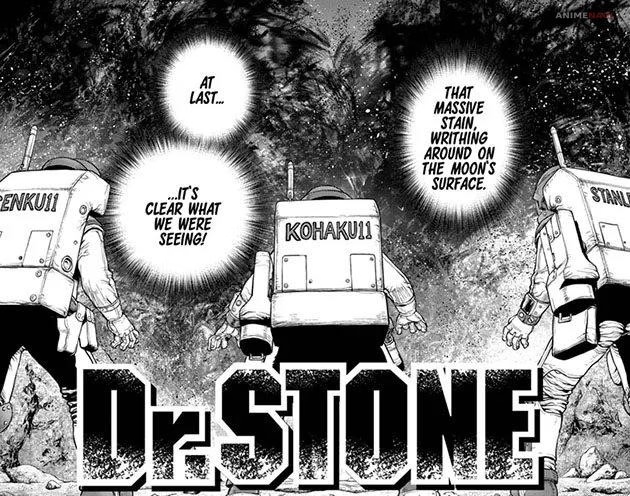
The Moon Mission Arc focuses heavily on rocket development, satellite technology, and space travel. The Kingdom of Science creates equipment capable of scanning the lunar surface, eventually identifying a strange dark mass that appears connected to Why-Man’s location. This revelation confirms that the source of humanity’s petrification is not hiding somewhere on Earth. It has been watching from space the entire time.
Who is Why-Man in Dr. Stone?
The final answer is one of the manga’s most surprising twists. Why-Man is not a human, an alien commander, or a secret villain operating from the shadows. Instead, Why-Man is the Medusa devices themselves.
When Senku and his team arrive on the Moon, they discover a massive cluster of Medusa units gathered together. These devices are revealed to be intelligent machine lifeforms capable of communication, independent thought, and collective decision-making. The giant black mass seen on the Moon is actually a swarm of Medusas acting as a unified consciousness.
This means the very technology responsible for petrifying humanity is also the intelligence behind Why-Man. Throughout the story, the villain was never a person. It was an entire species of advanced extraterrestrial machines. The revelation explains why Why-Man seemed so difficult to understand. Its motivations and logic were never human to begin with.
What exactly are the Medusa devices?
Before the final reveal, the Medusa devices appear to be powerful technological weapons capable of turning living organisms into stone. They first become a major focus during the Treasure Island storyline, where characters use them as strategic weapons.
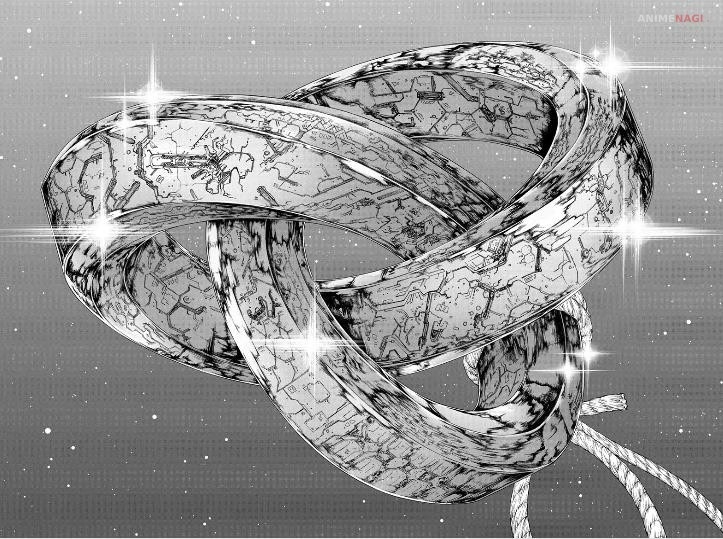
The truth is much stranger. The Medusas are living mechanical organisms that travel through space searching for intelligent civilizations. Unlike ordinary machines, they possess awareness and operate as a collective species. They can communicate through electromagnetic signals and survive in the vacuum of space.
The petrification beam is not intended as a weapon from the Medusas’ perspective. Instead, they view it as a gift. Petrification preserves consciousness, heals injuries upon revival, and dramatically extends life. Because of this, the Medusas believe they are helping intelligent species achieve a form of immortality.
This misunderstanding becomes the foundation of the conflict between humanity and Why-Man. The Medusas genuinely believe they are offering a beneficial technology, while humans see the petrification event as a catastrophe that destroyed civilization.
Why did Why-Man petrify humanity?
The answer lies in the Medusas’ survival strategy. These machine organisms require maintenance and reproduction, but they cannot fully sustain themselves forever. They depend on intelligent life forms to repair damaged units and create new ones.
When the Medusas discover a technologically capable species, they petrify that civilization. From their perspective, the process grants immortality and demonstrates the incredible value of their technology. They expect the revived civilization to appreciate the gift and willingly maintain the Medusas in return.
Humanity, however, reacts differently than expected. Instead of embracing the petrification technology as a blessing, people view it as a threat. Even after learning that petrification can heal injuries and potentially prolong life, humanity remains unwilling to become servants of the Medusas.
This creates a major philosophical divide. The Medusas cannot understand why humans reject what they consider eternal life. Humans, meanwhile, value freedom, mortality, and self-determination more than endless existence.
Why did Why-Man use Senku’s voice?
One of the creepiest elements of the series involves Why-Man mimicking Senku’s voice during transmissions. The mystery generates countless fan theories before the truth is revealed.
The explanation is surprisingly straightforward. The Medusas are capable of intercepting and reproducing radio signals. After observing human communications, they learn how to imitate voices and broadcast messages. Senku becomes a particular target because he represents humanity’s greatest scientific mind and the person most likely to understand them.
By copying Senku’s voice, Why-Man attempts to communicate using a familiar signal. Unfortunately, the strategy only makes the transmissions more disturbing and confusing. Rather than creating trust, the imitation convinces many characters that they are dealing with a dangerous and manipulative enemy.
The voice mimicry highlights the broader communication problem between humans and the Medusas. Both sides possess intelligence, but neither fully understands the other’s values or thought processes.
The final confrontation on the Moon
Unlike many shonen series, Dr. Stone does not conclude with a traditional battle against its ultimate villain. Instead, the climax revolves around scientific reasoning, debate, and communication.
When Senku finally encounters Why-Man, he does not defeat it through force. He explains humanity’s perspective and challenges the Medusas’ assumptions about life. Senku argues that mortality is an essential part of being human. The knowledge that life is finite drives innovation, ambition, relationships, and progress.
This conversation becomes the emotional core of the ending. The Medusas begin questioning their own worldview for the first time. They realize that their definition of salvation may not apply universally to every intelligent species.
The moment perfectly reflects Dr. Stone’s identity as a science-focused series. The final obstacle is solved not through combat but through understanding, logic, and the exchange of ideas.
Why one Medusa chooses to stay with humanity
After learning humanity’s viewpoint, most of the Medusa swarm decides to leave Earth and continue searching the universe. They conclude that humans are not suitable partners under their current approach.
However, one Medusa becomes fascinated by humanity’s potential. Instead of departing, it chooses to remain on Earth and cooperate with Senku and the Kingdom of Science. This decision represents one of the most important moments in the ending.
The surviving Medusa is no longer an enemy. It becomes a scientific collaborator interested in humanity’s capacity for innovation. The choice symbolizes mutual understanding between two vastly different forms of intelligence.
Rather than ending with total victory or destruction, Dr. Stone concludes with coexistence. Humanity gains access to incredible technology, while the Medusa gains a chance to learn from a civilization that values growth over immortality.
What the Why-Man reveal means for Dr. Stone’s themes
The Why-Man reveal works because it reinforces the themes that have defined Dr. Stone from the beginning. The series has always celebrated science as a tool for progress rather than domination. Even the greatest mysteries eventually receive rational explanations grounded in technology and discovery.
Why-Man also represents a warning about scientific advancement without understanding human values. The Medusas possess incredibly advanced technology, yet they fail to understand the emotional and philosophical needs of the people they encounter.
Senku’s victory ultimately comes from balancing scientific curiosity with humanity. He embraces progress while recognizing that technological power alone cannot solve every problem. The ending argues that science is most valuable when it improves human life rather than controlling it.
This message becomes especially important in a story centered around rebuilding civilization. The Kingdom of Science succeeds because it combines knowledge, empathy, and cooperation. Why-Man’s failure stems from overlooking those same qualities.
Does Why-Man return after the ending?
The main conflict concludes once the Medusas leave Earth, but the story hints at future possibilities. The remaining Medusa continues assisting scientific development, opening the door for technological breakthroughs far beyond modern capabilities.
One of the manga’s final ideas involves research into time travel. Senku becomes interested in using advanced science to potentially prevent the original petrification disaster altogether. While the series ends before fully exploring this concept, it demonstrates that humanity’s scientific journey is far from over.
Rather than presenting a definitive ending, Dr. Stone closes with optimism. The mystery of Why-Man is solved, but countless new discoveries remain waiting in the future. That sense of endless curiosity perfectly captures the spirit of the series.
Final thoughts
Why-Man’s identity is one of the most ambitious reveals in Dr. Stone. After years of speculation, the series reveals that humanity’s greatest enemy was never a hidden mastermind. It was an intelligent species of extraterrestrial machines known as the Medusas. Their petrification technology, mysterious Moon presence, and strange communications all connect to a mission they believed would help intelligent life achieve immortality.
The reveal transforms the story from a survival mystery into a philosophical discussion about science, mortality, and human progress. Instead of defeating Why-Man through violence, Senku changes its perspective through reason and understanding. That approach feels uniquely fitting for a series built around scientific discovery.
In the end, Why-Man is not simply a villain. It is a reflection of Dr. Stone’s central question: how should humanity use knowledge and technology to shape its future? The answer, according to Senku, lies not in escaping humanity but in embracing it.
Another important detail about Why-Man is that the Medusas never viewed themselves as villains. Throughout Dr. Stone, the Kingdom of Science assumes that the petrification event was a deliberate attack meant to wipe out humanity. However, the Moon reveal shows that the Medusas believed they were helping civilization evolve.
Their logic was based on the idea that immortality and endless healing would naturally be accepted as gifts. This twist makes Why-Man more complex than a traditional antagonist because its actions came from a completely different understanding of life rather than hatred or conquest.
The reveal also recontextualizes many earlier mysteries in the story. Why-Man’s repeated broadcasts of “Why?” were not threats but genuine confusion. The Medusas could not understand why humans rejected petrification despite its ability to preserve life, heal fatal injuries, and prevent aging.
From their perspective, humanity’s resistance seemed irrational. That misunderstanding becomes one of the strongest themes in the ending, showing how even advanced intelligence can fail when it cannot understand another species’ values and emotions.
Many fans consider the Why-Man reveal one of the boldest twists in modern shonen manga because it avoids the usual final-villain formula. Instead of exposing a hidden king, evil scientist, or godlike conqueror, Dr. Stone introduces a morally complex machine species whose goals are neither entirely good nor evil.
The ending stays faithful to the series’ science-driven identity by solving the central conflict through communication, observation, and reasoning rather than a massive final battle. That approach helps the Moon Mystery stand out as one of the most unique conclusions in recent anime and manga storytelling.