
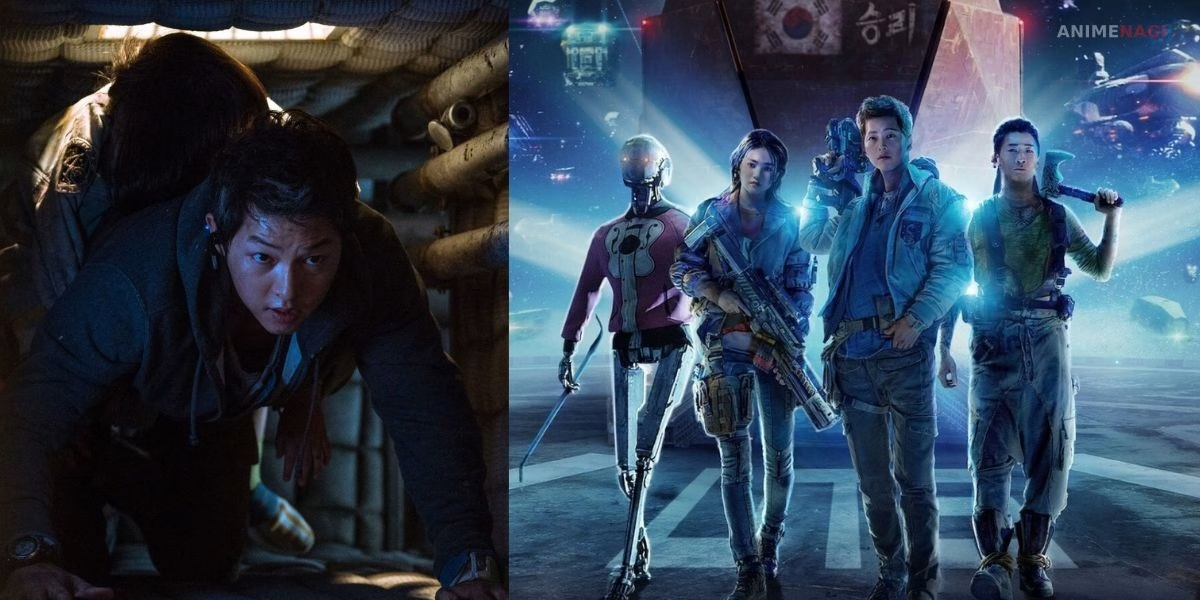
When Space Sweepers debuted on Netflix in 2021, it carried a distinct positioning: South Korea’s first major space blockbuster. Viewers were not only anticipating spectacle, but also looking for confirmation that Korean filmmaking could extend its narrative strengths into a genre traditionally led by Hollywood.
Directed by Jo Sung-hee, the film does not aim to radically redefine science fiction conventions. Instead, it works within established genre frameworks, layering them with grounded character development and a broader, international sensibility. The outcome is a film that remains engaging throughout, occasionally inconsistent, but ultimately rewarding.
Set in the year 2092, the story unfolds in a future where Earth has become largely uninhabitable due to environmental collapse. Society is sharply divided. The elite reside in a controlled orbital habitat operated by UTS, while the majority survive either in orbit or on the deteriorating planet itself, relying on unstable and underpaid labor. This socio-economic divide forms the structural core of the film’s world-building.
Rather than depicting space as a world of exploration, the Space Sweepers film presents it as an extension of existing economic hierarchies. Workers salvage debris under dangerous conditions, competing for scraps that barely sustain them. The tone aligns less with idealized exploration narratives and more with industrial labor dynamics transposed into orbit. This approach gives the environment a textured, lived-in realism that contrasts with more polished portrayals of space.
The Victory Crew: Characters and Performances
At the center is the crew of the spaceship Victory, a group defined more by necessity than cohesion. Song Joong-ki portrays Tae-ho, a former elite pilot now burdened by debt and lingering guilt. His performance is notably restrained, focusing on internal tension rather than overt emotional display.
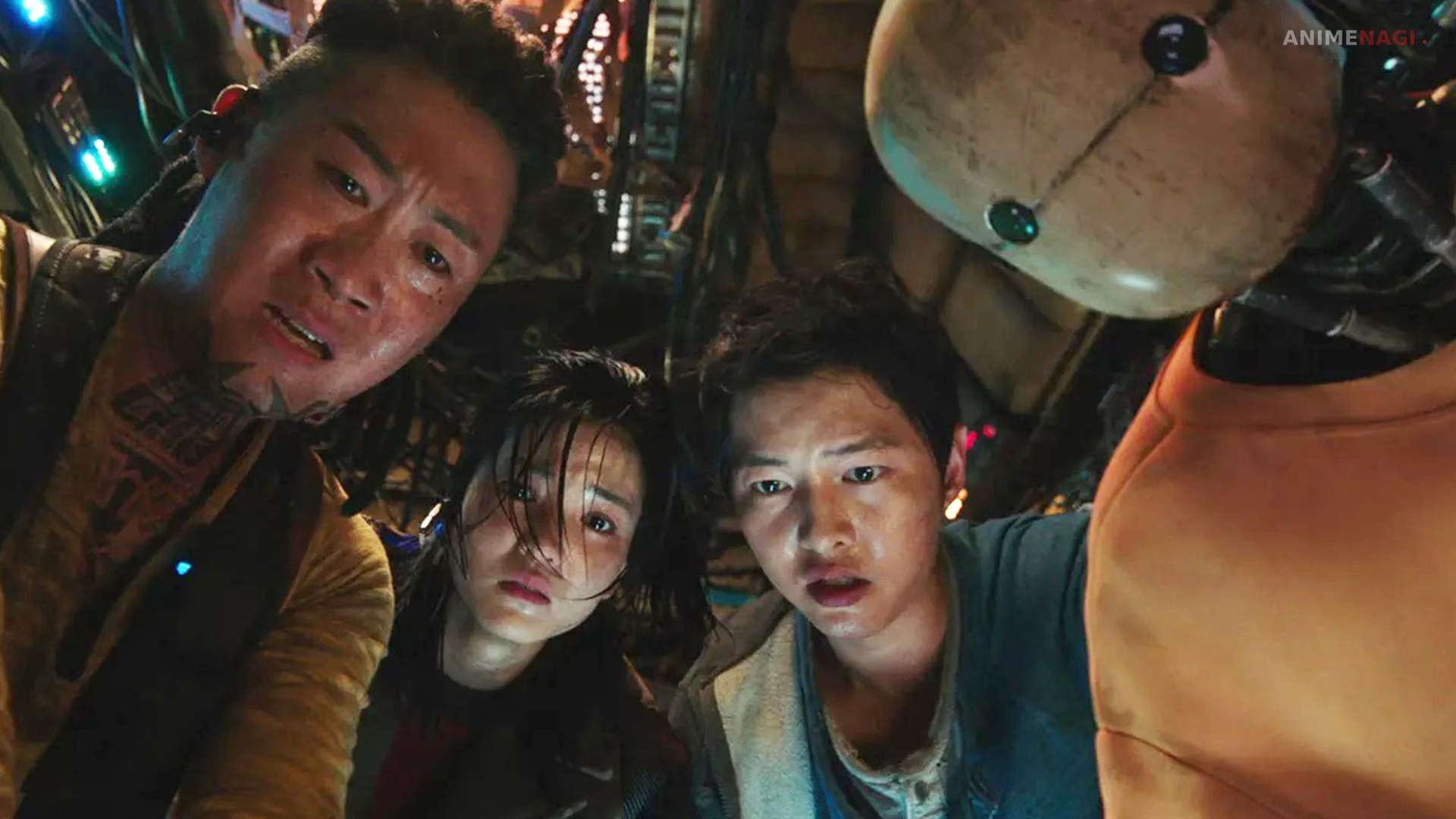
Opposite him, Kim Tae-ri plays Captain Jang, delivering a composed and authoritative presence. The character prioritizes survival with little room for sentimentality. Jin Seon-kyu brings unpredictability and humor as Tiger Park, while Yoo Hae-jin voices Bubs, a robot that introduces levity without diminishing narrative stakes.
The group dynamic develops gradually. Initial interactions are transactional, shaped by financial pressure. Over time, these relationships evolve into a form of trust, though the film avoids exaggerated emotional shortcuts. This progression is critical, as the narrative’s emotional impact depends on the audience accepting the crew as a functional unit.
The story shifts when the crew encounters a young girl known as Dorothy. Initially believed to be a weapon of mass destruction, she becomes central to the unfolding conflict. What begins as a financial opportunity evolves into a moral dilemma, compelling each crew member to reconsider their priorities.
Dorothy’s introduction alters the narrative focus. The film transitions from episodic salvage operations to a more concentrated exploration of protection, exploitation, and identity. While the “child with hidden power” trope is familiar, the film integrates it effectively by linking Dorothy’s role to systemic issues rather than using her purely as a plot mechanism.
From a technical perspective, the film demonstrates strong production capability. The visual effects, while not flawless, remain consistently credible. Space is depicted as congested and hazardous, filled with debris, competing vessels, and continuous movement. This density reinforces the idea of space as a workplace rather than a frontier.
The action sequences are particularly effective in the early salvage scenes, which emphasize speed, precision, and environmental danger. As the film progresses, these sequences scale up, incorporating broader conflicts and more intricate choreography. Although rapid editing occasionally impacts clarity, the overall execution maintains tension.
Production design is especially notable. The Victory’s interior is cramped and utilitarian, reflecting the crew’s financial limitations. In contrast, the UTS habitat is sleek and sterile, visually reinforcing class divisions without the need for explicit exposition.
Thematically, the film touches on environmental degradation, corporate dominance, and social inequality. Earth’s condition highlights the consequences of unchecked industrial expansion, while UTS represents a form of corporate governance where survival conditions are dictated by private interests.
There is also a strong emphasis on multicultural interaction. Characters frequently switch between languages within the same conversation, suggesting a future where national distinctions are less rigid. This detail enhances authenticity and supports the film’s global perspective.
However, these themes are not deeply interrogated. They serve more as contextual framing than as subjects of detailed exploration. The narrative prioritizes pacing and accessibility, which limits the depth of thematic analysis. This broadens its appeal but leaves some conceptual avenues underdeveloped.
Structurally, Spacesweepers shows some imbalance. The opening act is dense, introducing setting, characters, and socio-political context in rapid succession. This can feel overwhelming, particularly for viewers expecting a more gradual narrative build.
As the film continues, the pacing becomes more controlled. The central conflict gains clarity, and the storytelling becomes more focused. The latter half benefits from this adjustment, offering stronger emotional engagement, though the initial density remains a noticeable barrier.
The primary antagonist, connected to UTS leadership, functions adequately within the plot but lacks depth. His motivations align with the film’s critique of corporate power, yet he is not developed sufficiently to stand out as a compelling character.
This limitation does not significantly weaken the film, as the narrative tension is driven more by the crew’s internal decisions. However, a more nuanced antagonist could have strengthened the overall conflict and thematic contrast.
Upon release, Space Sweepers achieved wide international reach through Netflix, entering top 10 rankings across multiple regions. Its performance demonstrated that non-English-language science fiction can attain mainstream visibility without relying on Western production models.
Critical reception was generally positive. Reviews highlighted its visual ambition and character dynamics, while acknowledging its reliance on familiar narrative structures. It was widely regarded as a solid, though not groundbreaking, addition to the genre.
On Rotten Tomatoes, Space Sweepers holds a solid approval rating, reflecting a generally positive critical reception. Reviews on the platform tend to highlight the film’s ambitious visual scope, engaging ensemble cast, and accessible storytelling, even as some critics note its reliance on familiar genre tropes. The score reinforces its position as a well-executed, audience-friendly sci-fi entry rather than a genre-defining outlier.
Reception and Global Impact
From an industry standpoint, the film represents an important milestone. It underscores the feasibility of large-scale genre filmmaking within South Korea and reflects growing global demand for diverse storytelling approaches in science fiction.
Ultimately, Netflix’s Space Sweepers succeeds through execution rather than innovation. Its components are recognizable, but they are assembled with sufficient care to remain engaging. The emphasis on character relationships provides a stable foundation that compensates for structural and thematic limitations.
While it does not fully go to the depth of its setting or ideas, and its early pacing issues are evident, its strengths in production design, ensemble performance, and tonal consistency sustain its appeal.
The film operates both as a standalone work and as a demonstration of capability. It shows that high-budget, effects-driven science fiction can be produced outside Hollywood without compromising coherence or audience engagement.
Rating: ⭐ 7.5/10