
In Jujutsu Kaisen, few characters command as much fear and fascination as Ryomen Sukuna. Known as the King of Curses, Sukuna is already established as one of the most powerful beings in the series. However, creator Gege Akutami went a step further by describing him as a “natural disaster,” a label that carries deeper meaning than it initially appears.
This description has sparked discussion among fans, especially since translations vary between “calamity” and “natural disaster.” Regardless of wording, the intent remains clear. Sukuna is not just a villain. He is an uncontrollable force of destruction that reshapes everything around him. Let’s break down why this label fits so perfectly.
More Than a Villain: A Force That Cannot Be Stopped
Most antagonists in anime have motives, plans, or goals that can be understood or challenged. Sukuna operates differently. His existence alone brings chaos, and his actions are not driven by morality or ideology.
Even during his human life, Sukuna was feared as an unmatched sorcerer. That reputation carried over into his existence as a curse, amplifying his presence to something far more terrifying. Like a natural disaster, he does not need a reason to destroy. He simply does.
This unpredictability is what separates Sukuna from traditional villains. You cannot negotiate with a storm, and in the same way, you cannot reason with him.
One of the clearest examples of Sukuna’s “natural disaster” nature is his Domain Expansion, Malevolent Shrine. Unlike typical domains that create a contained space, Sukuna’s ability affects the real world directly, unleashing widespread destruction without barriers.
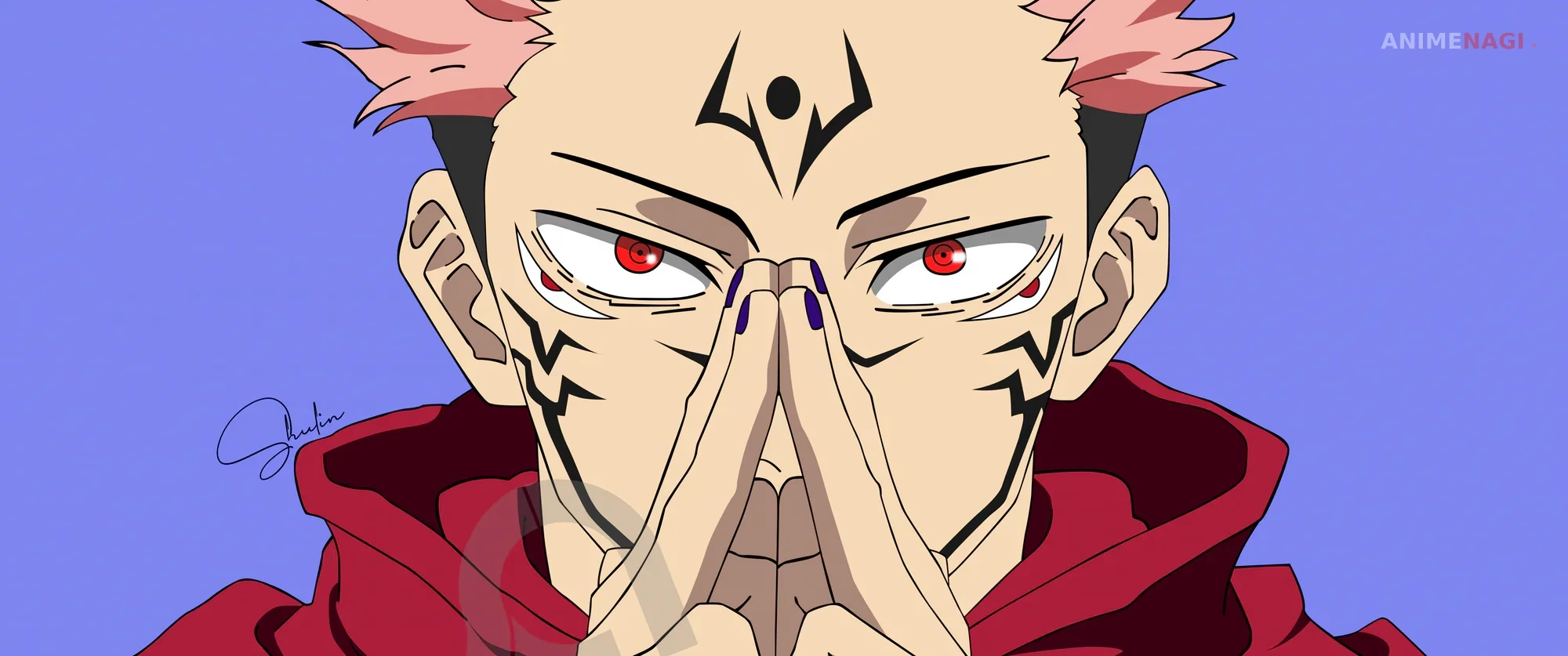
Everything within its range is relentlessly cut down, whether living or non-living. The scale and indiscriminate nature of this attack resemble a catastrophic event like a hurricane or an earthquake.
This is not targeted violence. It is total devastation. The environment itself becomes a casualty, reinforcing the idea that Sukuna functions more like a force of nature than a character with limits.
Interestingly, natural disasters are not purely destructive in a broader sense. While they cause immense damage, they can also lead to renewal and change. Forest fires clear space for new growth, and storms bring essential rainfall to dry regions.
Sukuna’s presence in the story follows a similar pattern. His actions push the world of jujutsu sorcery into a new era. Stronger enemies force stronger responses, and characters are compelled to evolve or perish.
The fall of powerful figures and the rise of new ones are direct consequences of the chaos he creates. In this way, Sukuna’s destruction becomes a catalyst for transformation rather than just an end.
Another reason Sukuna fits the “natural disaster” label lies in the nature of curses themselves. In Jujutsu Kaisen, curses are born from negative human emotions such as fear and hatred.
Characters like Jogo represent collective fear toward natural phenomena like volcanoes. Applying this logic, Sukuna can be seen as the embodiment of humanity’s fear of overwhelming power itself.
His legend as a human likely contributed to this perception. The fear he inspired may have played a role in shaping his identity as a curse, turning him into something larger than life.
In that sense, Sukuna is not just compared to a natural disaster. He is one in concept, formed from fear and sustained by it.
Some official translations refer to Sukuna as a “calamity” instead of a “natural disaster.” While the wording differs, the meaning remains aligned.
A calamity implies large-scale suffering and destruction, often beyond human control. This still captures Sukuna’s essence. Whether described as a disaster or a calamity, the key idea is that he exists outside the boundaries of normal conflict. He is not a problem to be solved. He is an event to survive.