
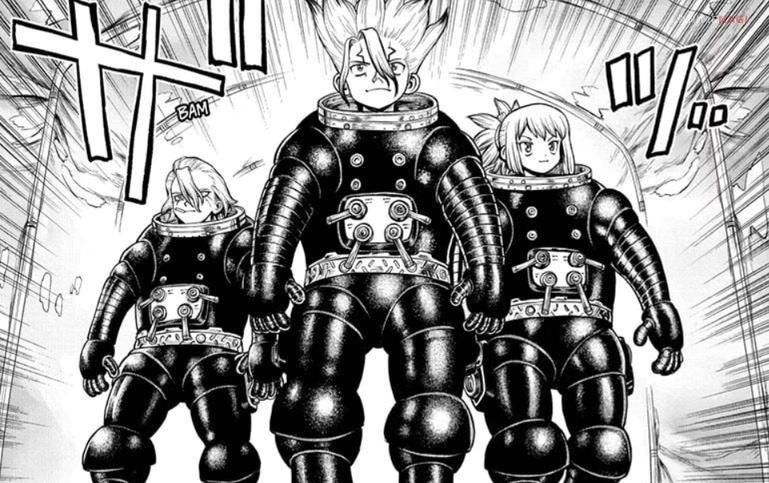
The ambitious moon mission in Dr. Stone pushes science to its absolute limits, and one of its most fascinating elements is how Senku Ishigami approaches building space suits. Unlike modern engineers who rely on decades of technological infrastructure, Senku must recreate everything from scratch in a post-apocalyptic world.
This challenge is not just about crafting protective gear, but about understanding the real science behind space survival. A functional space suit must handle extreme temperatures, provide oxygen, maintain pressure, and protect against radiation. The series takes a grounded approach by breaking down these concepts into achievable steps using available materials and scientific principles.
Senku’s process reflects the core theme of Dr. Stone, which is rebuilding civilization through knowledge. Let’s break down how space suits work in real science and how Senku realistically recreates them for humanity’s journey to the moon.
The Core Functions of a Real Space Suit
A space suit is essentially a personal spacecraft that keeps astronauts alive in the vacuum of space. It must provide oxygen, regulate temperature, and maintain internal pressure to prevent the human body from collapsing. Without these systems, survival in space would be impossible.
Modern suits, like NASA’s Extravehicular Mobility Units, are made with multiple layers. These layers protect against micrometeoroids, radiation, and extreme temperature fluctuations. Senku’s challenge lies in replicating these functions without access to advanced factories or synthetic materials.
One of the most critical parts of a space suit is its life support system. Senku focuses on generating oxygen through chemical reactions and storing it efficiently. Using his deep understanding of chemistry, he can recreate oxygen tanks and filtration systems from basic resources.
Maintaining pressure is equally important, as space is a vacuum. Senku would need airtight seals and durable materials to prevent leaks. By combining rubber, resins, and reinforced fabrics, he can approximate the sealed environment required for human survival.

Materials and Layering: Rebuilding Advanced Protection
Creating a protective outer layer is one of the toughest challenges. Real space suits use advanced composites, but Senku adapts by using layered fabrics, metals, and insulation techniques. These layers help regulate temperature and provide a barrier against external hazards.
Thermal control is especially important because space has no atmosphere to distribute heat. Senku applies real-world principles like reflective surfaces and insulation to manage heat transfer. This approach mirrors how actual space suits use layered protection to maintain stable internal conditions.
Even with oxygen and protection, a space suit must allow movement. Stiff materials and pressure resistance can make mobility difficult. Senku tackles this by designing flexible joints and mechanical support systems.
Precision engineering becomes crucial at this stage. Every seal, joint, and connection must function perfectly to avoid fatal failures. This reflects real aerospace challenges, where even small errors can have catastrophic consequences.